


Last month was eggplant. This month I’m breaking my own rule, because pasta isn’t technically one ingredient. It’s flour and water, sometimes eggs, and a few thousand years of grandmothers being very particular about it. But October is National Pasta Month, and if I’m being honest, this is the issue I’ve been waiting to write since I started this newsletter. Pasta isn’t one of my favorite foods. It’s the favorite food. It always has been.
I grew up on it. We had pasta at least 3 times a week. My mom always got creative with the sauce, the soul of the dish, whether it was meat, veggies, or seafood. I got so used to it that I was genuinely confused whenever I ate at a friend’s house and their family served something else.
My all time favorite, to this day, is my mom’s pesto. It’s not traditional, and she changes it up constantly. Sometimes it’s walnuts, sometimes pine nuts. I’ve caught her sneaking in ricotta. I’ve caught her sneaking in milk. Every single time it was so good I could have drunk the sauce.Pesto still has my heart. Doesn’t matter the season.
And I still order it almost every time I go out. Nine times out of ten, if there’s pasta on the menu, that’s what I’m getting, and I’ve made peace with that. People think ordering pasta is the safe choice. I think it’s the opposite. A plate of pasta is the most honest thing a kitchen can send out. There’s nowhere to hide: it’s flour, water, salt, heat, and someone who knows exactly when to pull it. A great steak is mostly a great cow. A great cacio e pepe is all skill. If a restaurant can do pasta right, I trust it with almost everything else.
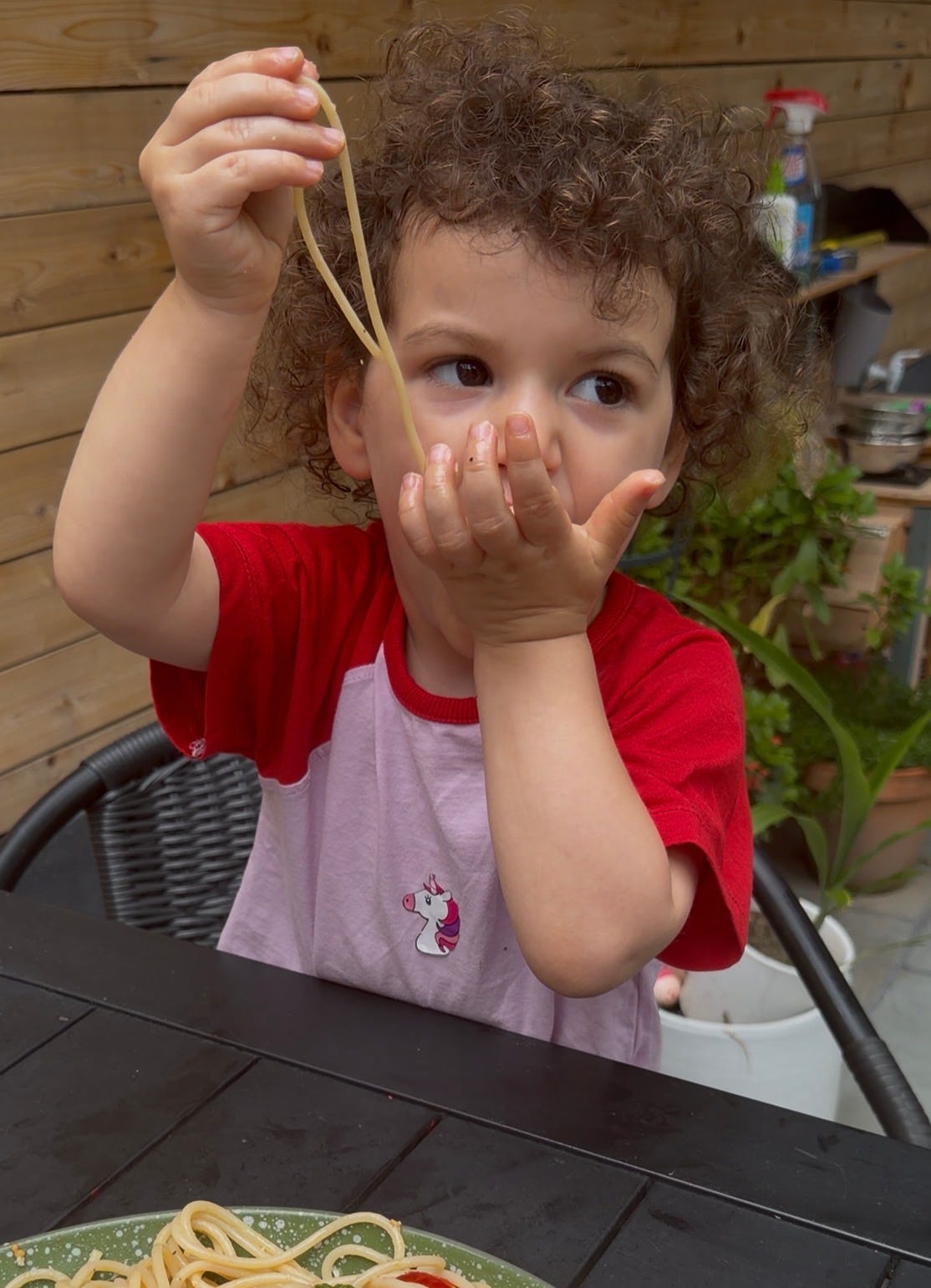
So I need to say this clearly: pasta is not “just a quick weeknight dinner.” It CAN be, and thank god, because some nights that box of rigatoni and canned tuna saves my life. But it’s also the Sunday project that takes all afternoon. It’s what you make when someone’s grieving, celebrating, or just walked in the door hungry, and you love them. In Italy, pasta is a primo, a first course. It’s not the whole meal, and you don’t eat it standing at the counter. You sit down, you eat it slowly, you talk, you have a glass of wine, and maybe you go for a little walk after. That’s how I want to eat it, even on a Tuesday. Pasta shows up just as much in my life today. On a special night, I make it from scratch, but more often, I make it at least twice a week. But more for my daughter, who is the biggest fan of parm, egg, butter, and pasta. Can you blame her?
Another reason pasta is on my mind this month is that I can’t say much yet. Something I’ve been working on for a long time launches at the end of October, and it’s very much in this spirit: a pot of boiling water, good company, and the step everyone skips. Stay tuned.
A quick lesson before we eat (it’ll make you a better orderer, I promise)
There are really two great pasta traditions in Italy, and once you know which one you’re eating, menus start to make sense.
Down south, in Campania, Puglia, and Sicily, pasta is pasta secca: dried, made from durum wheat semolina and water. Eggs were historically too precious to put in everyday food. This is your boxed pasta: spaghetti, rigatoni, paccheri, bucatini. It loves olive oil, tomato, garlic, and anything with bite.
Up north, especially in Emilia-Romagna, where eggs, butter, and cheese were everywhere, pasta is pasta fresca all’uovo: fresh, soft flour and egg, rolled into sheets and cut or folded by hand. That’s where tagliatelle, tortellini, ravioli, and lasagne come from. It wants butter, cream, broth, and a light hand.
Neither is better. (I’ll fight anyone who says fresh is always better.) They’re just different. When you’re choosing a shape to go with a sauce, the rule of thumb is simple: long pasta wants a sauce that coats, short pasta wants a sauce that gets caught in the ridges and tubes, and stuffed pasta wants a sauce that stays out of the filling’s way. Drowning a delicate tortellini in heavy red sauce is a crime (we can fight about this in the comments)
This might just be me, myself, and I, but there are two pasta shapes I think are totally overrated.
#1: Bowties. Yes, they’re super cute, and kids love picking them up. But they cook unevenly every single time.
#2: Angel hair. Yes, it’s thin and delicate, and you feel light after. But c’mon. It sticks together, it overcooks in seconds, and it literally tangles like hair. I’ll happily order it at a restaurant, but I’d rather not deal with it at home. Where I eat it
These are the places I keep going back to, and what I order when I get there. This isn’t a “best pasta in NYC” list. Plenty of those exist already. These are my places.
I have to start here, and I’m not even going to pretend to be objective. I used to work at Misi. I worked the steak station (yes, the steak station, at a pasta restaurant, I know), but I ate pasta every single night. It’s a very specific kind of education, eating the same menu night after night and watching how it’s made. You learn that the best food in the world is usually the simplest, and that simple is the hardest thing there is.


Family meal is a sacred part of working in any kitchen. It’s fast and slow at the same time. Prep’s done, the clock’s ticking, and for 20 minutes the whole team just pauses. Sometimes it’s loud, everyone talking over each other. Sometimes it’s total silence, heads down, refueling before service. But it was always consistent, always delicious, and always a group effort.
At Misi, family meal was fun. They took requests. I remember gourmet hot dog day. Lasagna day. Cobb salad day. And whoever got assigned to cook took it way too seriously, in the best way. Nobody wanted to be the one who served sad pasta to a room full of cooks.


Misi had a certain hum to it, because the kitchen and the dining room blended into one. An open kitchen has so many pros and cons, and for me, the pros win. I loved talking to guests about the dishes and the ingredients. But that same pro turns into a con real fast when your all-day has 11 items, all due a minute ago. But Misi on a saturday night around 8pm. I didn’t know I could move that fast, hearing five callouts at once while talking to a guest at the same time. Those nights were a total blackout, the wildest kind. But somehow we always got it done, and every guest left beyond happy and very, very full. One thing I took with me from Misi: fennel pollen on steak. Not exactly traditional, maybe even an acquired taste, but I fell in love with it. I’ve been finishing almost every steak with it ever since.
Missy Robbins opened Misi in 2018 as the younger sibling to Lilia, and the pasta is made by hand in a glass-walled room you can see from the dining room. My order is, honestly, everything. I think dining at Misi is more about ordering with balance. You need two pastas or three…My go-to were the occhi + linguine. You need at least 2 veg dishes; these were more seasonal, but they kept coming back for the most part. My go to were baby artichokes + leeks. Lastly, I always ordered the steak.
LaRina Pastificio & Vino, Fort Greene
I lived on Myrtle Avenue for nine years, and for a long time it wasn’t really a dinner street. LaRina changed that. It was the first truly great restaurant on that stretch, and it felt like it was made for the neighborhood. Silvia Barban, who grew up in northern Italy, opened it in 2016. Every pasta is made by hand in-house, and there’s a little market counter where you can take fresh pasta home by the pound. That counter was dangerous for me. When LaRina opened, it meant everything to me. Myrtle was lacking. LaRina was far from it.
It became my spot. Where I’d treat myself to dinner solo, and where I’d take my parents whenever they came to visit. For a while they sold fresh pasta and sauce from a little counter in the back, and I popped in constantly. It saved me on so many nights when I forgot to prep something or just needed a bowl of comfort. A chef who forgets to make her own dinner, I know. It happens more than you’d think. My order:
Starter: Pane & Olio + The Tonno
Pasta: Strozzapreti al Pomodoro or Lasagne Verdi


If you want to feel like you’ve left Brooklyn for a couple of hours, go here. Al Di Là is SO Italian. Anna Klinger and her husband, Emiliano Coppa, have run it on Fifth Avenue since 1998, and it has never once tried to be cool, which is exactly why it is. It’s Northern Italian through and through, which means fresh pasta, butter, and dishes that taste like someone’s Nonna has been making them forever. And it never misses. I’ve never had a bad thing there. If they’re open (they're Italian, they’re open when they want), you walk in and half the time you're welcomed with a kiss or hug. Then you're ignored, then you sit, and they tell you what to order. And ive never disliked a thing
Order the casunziei. They’re bright pink beet and ricotta ravioli in butter and poppy seeds, and they’re unlike anything else in the city: a little sweet, a little earthy, and almost too pretty to eat. Then get the malfatti, which literally means “badly made.” They’re Swiss chard and ricotta dumplings in brown butter and sage, lumpy and imperfect on purpose, and they’re perfectly imperfect.


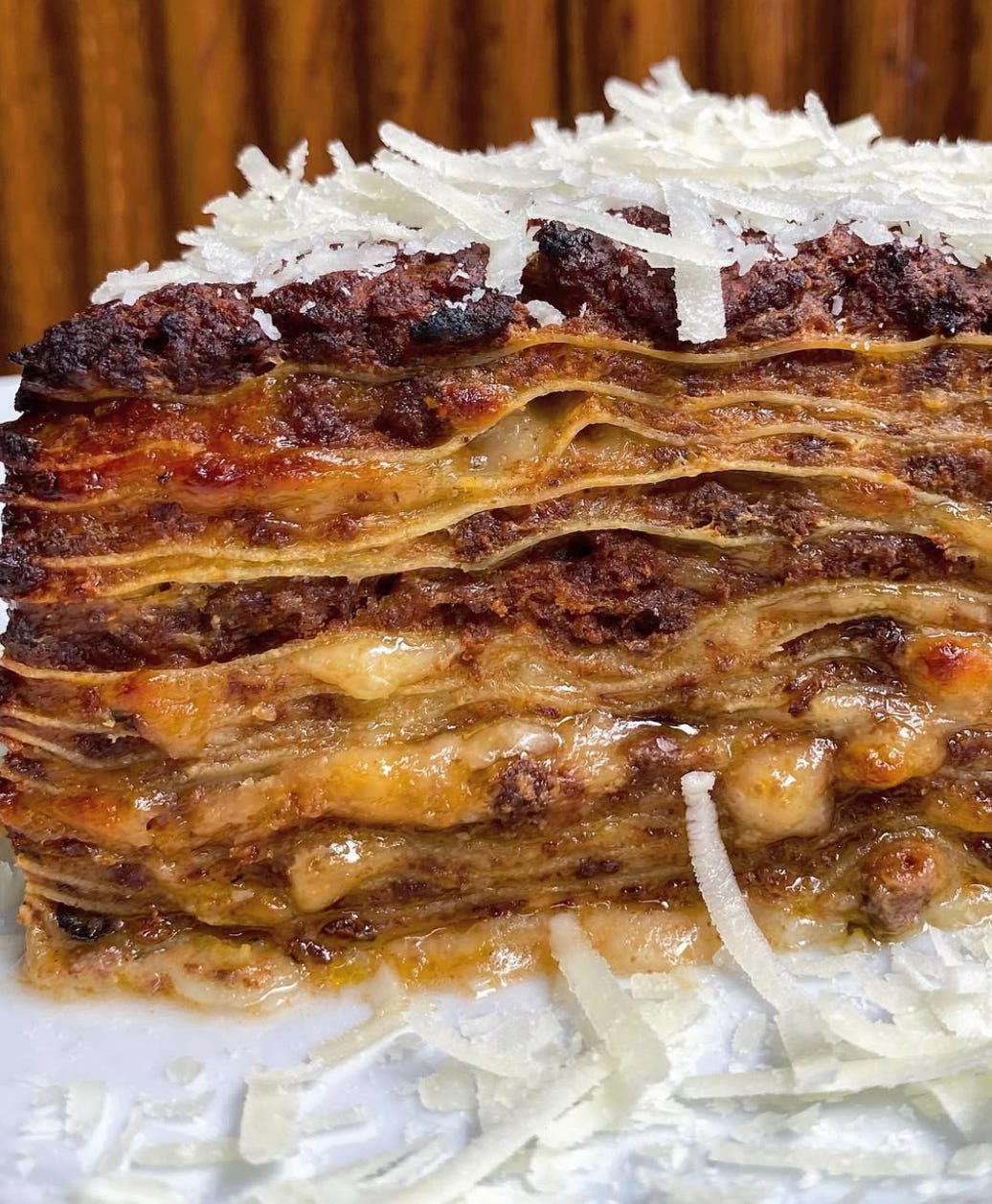
The lasagna. I grew up on my mom’s version. Saucy, decadent, special occasion only. So Rita Sodi’s confused me a little. It’s something like twenty paper-thin layers of fresh pasta, and the texture is closer to a custard than the slab you’re picturing. It tastes mostly like pasta, and that’s the point. It’s a lesson in restraint, and the room matches. I Sodi is quiet, almost library-like, unless you're dining there on a Saturday at 8pm, which is the perfect time to focus on one very good thing. My order: Lasagna.
Rita Sodi again, this time with her partner, Jody Williams, and this time for the cacio e pepe. Three ingredients: pasta, pecorino, black pepper. That’s it. It sounds like the easiest dish in the world, and it’s actually one of the hardest. Get the water or the heat a little wrong and the cheese seizes into clumps instead of turning into sauce. Via Carota’s is the best in the city. I hate lines. And this place always has one. My strategy is to get there early. Or make friends with the manager (which I've done, and then you don't wait). My order: Cacio e pepe + a Negroni Bianco
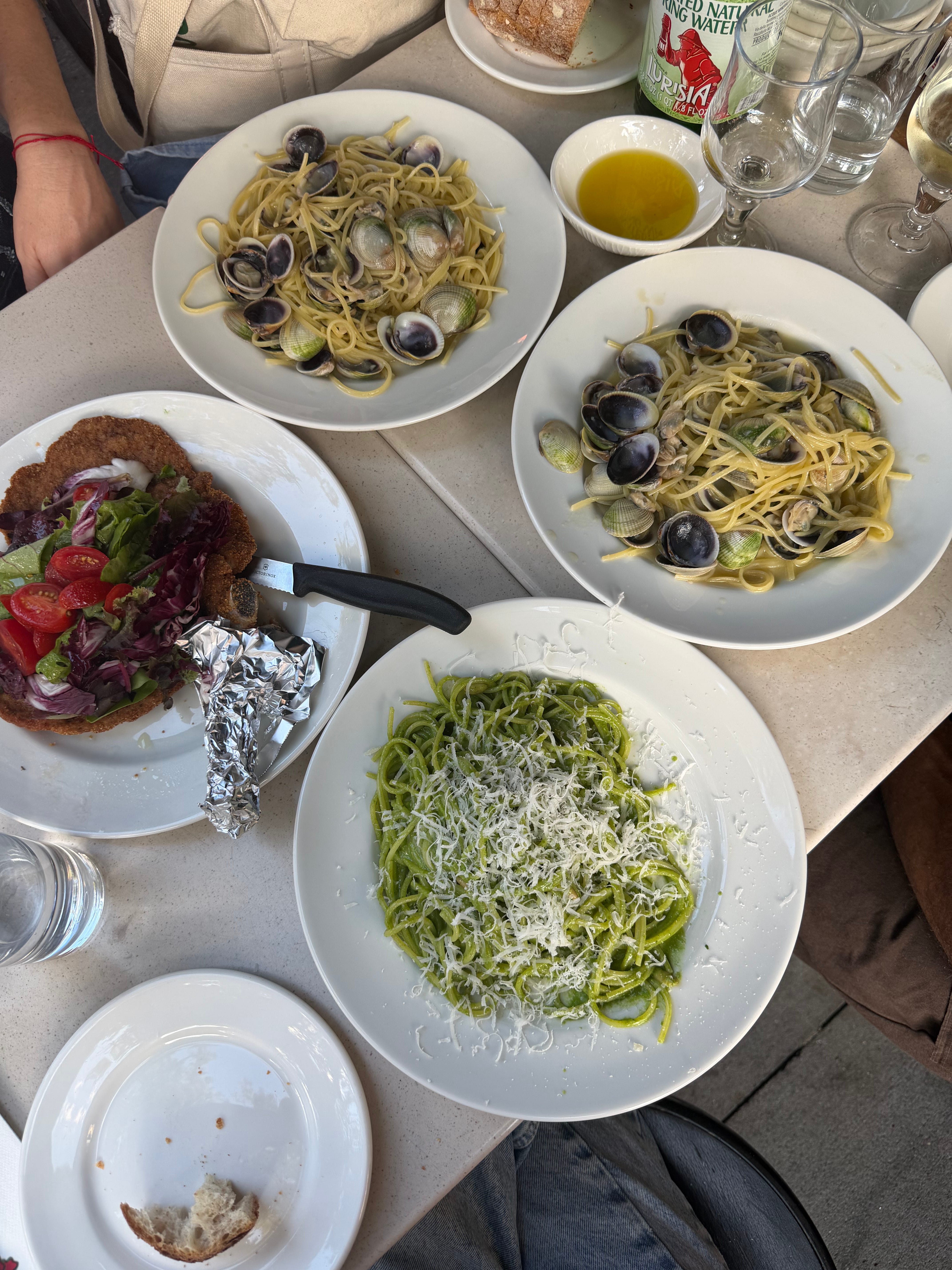
For the pesto. Bar Pitti on Sixth Avenue is loud, fast, cash only, and has looked exactly the same for as long as anyone can remember: specials on a chalkboard, everyone crammed onto the sidewalk the second it’s warm enough. It’s not fancy, and it doesn’t want to be. I prefer Bar Pitti as an unplanned adventure, and more so in the daytime. I will sit outside in all seasons (they have heaters), and I will forever order 3 things: Pesto + Milanese + Vongole. Somtimes together if I have friends, somthings seperate.
My advice: order everything. I mean it. Hillary Sterling cooks over live fire in a huge, light-filled room in Manhattan West, and her pasta section is one of the strongest in the city. The stracci with rabbit, white wine, and Parmigiano is the coziest thing on the menu, the kind of dish you want when it’s cold and dark at 5 p.m. The rapini agnolotti with ricotta, lemon, and chili and the cavatelli with crab, chili, and vermouth are both non-negotiable. And start with the caramelized onion torta with pecorino toscano and balsamic. It’s not pasta. You’ll thank me anyway. My Order: Caramelized Onion Torta, Gnocco Fritto, Stracci, Rigatoni Alla Gricia


Making it at home
These are the dishes I make when I can’t get a table, or when I don’t feel like putting on real pants. One rule before anything else: SALT THE WATER ;) Way more than you think. It should taste like a pleasant, salty broth, because it’s the only chance you get to season the pasta itself. Every great pasta starts there, and almost everyone skips it.
Cacio e Pepe, for nights when you can’t face the Via Carota line
serves 2
Three ingredients. That’s it. Cacio e pepe is proof you don’t need a lot to make something unforgettable. But because there’s nowhere to hide, every little step matters. Don’t worry, I’ve got you.
What you need
½ lb Bucatini or spaghetti (rigatoni works too)
1½ cups Pecorino Romano, grated super fine (the finer, the smoother)
1½ tsp black peppercorns, freshly cracked
Salt for the pasta water
How I make it
Toast the pepper. Crack your peppercorns coarsely and toast them in a dry pan over medium heat for about a minute, until your kitchen smells amazing. Turn off the heat and set the pan aside. This is where your sauce comes together, so don’t wash it.
Boil the pasta in less water than usual. Use a smaller pot with just enough water to cover the pasta, and salt it lightly since pecorino is already salty. Less water means starchier water, and starchy water is the secret to a creamy sauce.
Make your cheese paste. While the pasta cooks, put the pecorino in a bowl and add a few spoonfuls of pasta water. Stir it into a thick, creamy paste. Here’s the most important tip: let that water cool for a minute first. If it’s boiling hot, the cheese will clump, and nobody wants that.
Bring it together. Pull the pasta out a minute before al dente and toss it right into the pan with the pepper, along with a splash of pasta water. Keep the heat off. Add the cheese paste and toss, toss, toss like your life depends on it. Add more pasta water a little at a time until it turns glossy and silky and coats every strand.
Eat it now. Cacio e pepe waits for no one. Plate it, add one more crack of pepper and a little more pecorino on top, and go.
If it clumps, your pan was too hot. Add a splash of warm pasta water and keep tossing, and it usually comes back. And if all else fails, it’ll still taste great.


Pistachio Pesto Pasta with Ricotta with Brami (bc we need protein in this dish)
serves 2 to 3
You already know pesto has my heart. This one is a nod to my mom, who was always sneaking things into hers, so I’m sneaking in pistachios and a little ricotta. It’s creamy, nutty, bright, and made with Brami, so it actually keeps you full. Pesto that loves you back.
What you need
1 box Brami pasta, any shape you love (something with ridges or twists really grabs the pesto)
2 big handfuls of fresh basil, about 2 packed cups
½ cup shelled pistachios, unsalted
½ cup Parmigiano, grated
1 small garlic clove
½ cup good olive oil
¼ cup ricotta, plus a little extra for the top
Zest and a squeeze of half a lemon
Salt and pepper
How I make it
Toast the pistachios. Throw them in a dry pan over medium heat for 3 to 4 minutes, until they smell nutty. Save a small handful, chopped, for the top.
Blend the pesto. Add the basil, pistachios, garlic, parm, lemon zest, and a pinch of salt to a food processor. Pulse, then stream in the olive oil until it’s smooth but still has a little texture. Then add the ricotta and pulse a couple more times. That’s what makes it so creamy.
Cook the Brami. Follow the timing on the box and save a cup of pasta water before you drain.
Toss it together. Off the heat, toss the pasta with the pesto and a splash of pasta water until it’s glossy and coats everything. Add more water a little at a time if it’s too thick. Keep it off the heat, because hot pans turn basil dark and sad.
Finish it. A spoonful of ricotta on top, the chopped pistachios, a squeeze of lemon, and some cracked pepper.
My tip: Taste before you serve. Pesto always needs a little more of something, whether that’s salt, lemon, or parm. Trust your gut and tastebuds. They know what they want!


Brown Butter and Sage Ravioli, for the Al Di Là and Misi devotees
serves 4
Brown butter and sage is one of those combos that tastes way fancier than it is. Nutty, crispy, a little salty, and done in about five minutes. You can make your own ravioli if you’ve got the time and the love, or grab a good store bought one. No judgment here, I do both.
The sauce
6 tbsp unsalted butter
12 to 15 fresh sage leaves
Parmigiano, for grating
Flaky salt, black pepper, and a little lemon zest
Option 1: Buy it
Pick up 1 to 1½ lbs of fresh ricotta or butternut squash ravioli from your favorite Italian market or the fresh pasta section. Fresh beats frozen here. Then skip straight to cooking.
Option 2: Make it
The dough
2 cups 00 flour, plus extra for dusting
3 eggs
The filling
1 cup whole milk ricotta, drained
½ cup Parmigiano, grated
1 egg yolk
Zest of half a lemon
A pinch of nutmeg, salt, and pepper
Make the dough. Mound the flour on your counter, make a well in the middle, and crack in the eggs. Whisk them with a fork, slowly pulling in flour, then knead for 8 to 10 minutes until smooth. Wrap it and let it rest for 30 minutes.
Make the filling. Mix everything together and pop it in the fridge while the dough rests.
Roll it out. Roll the dough as thin as you can, until you can almost see your hand through it. A pasta machine makes this way easier.
Fill and shape. Dollop teaspoons of filling about 2 inches apart on one sheet, brush a little water around each one, then lay a second sheet on top. Press around each mound to push the air out, then cut them into squares. Air bubbles are what make ravioli burst, so take your time.
Bring it together
Cook the ravioli. Drop them into well salted boiling water. Fresh homemade takes 2 to 3 minutes; store bought, follow the package. They’re done when they float. Save a little pasta water.
Brown the butter. While they cook, melt the butter in a big pan over medium heat. Once it’s foaming, add the sage. Swirl until the butter turns golden brown and smells like toasted hazelnuts and the sage is crispy, about 3 to 4 minutes. Watch it closely, because brown butter turns to burnt butter fast.
Toss gently. Move the ravioli straight into the pan with a splash of pasta water and give them a gentle swirl until they’re glossy.
Finish it. Lots of grated parm, flaky salt, cracked pepper, and a little lemon zest to brighten it all up.
My tip: For an October version, swap the ricotta filling for roasted butternut squash mashed with parm and a pinch of nutmeg. Same sauce, but give it a fall moment!
The point
Pasta is more than dinner. It’s comfort, it’s family, it’s pure joy, it’s dopamine. It’s my absolute favorite thing. It’s the kind of dish that comforts you twice, once when you make it and again when you eat it.
Name one time you ate pasta and were unhappy. I’ll wait.
Life is short. Make a pot of something this week. Salt the water. Sit down and eat it.
Happy pasta month! 🍅
Xx
Gina